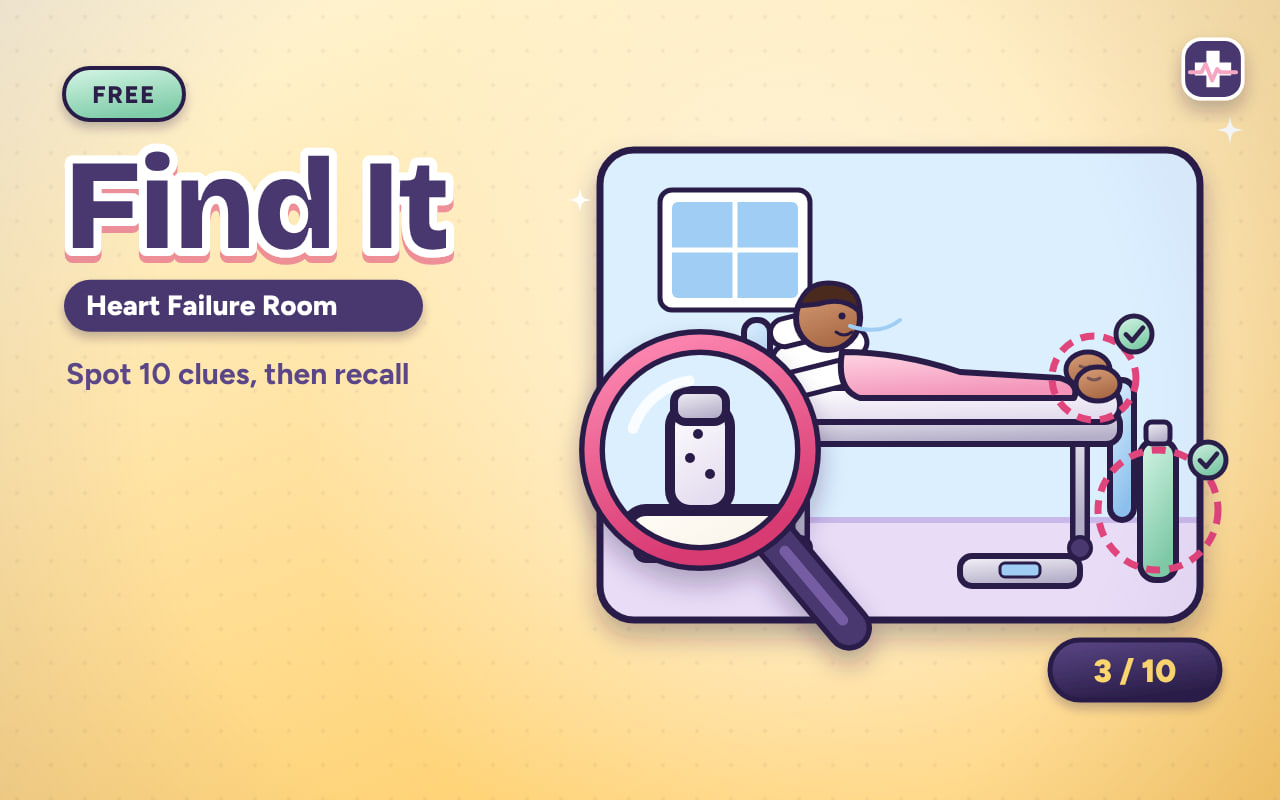
Find It: Heart Failure Room
Hunt the clues. Remember where you found them.
Included with Core and Elite. Make your account to start playing, and your 14-day free trial unlocks everything.
What it is
Find It is a seek-and-find memory game. Room 12 is a busy, hand-drawn patient room, and 10 heart failure facts are hidden inside it among dozens of everyday objects.
Hunt them down against the clock, with a hint when you need one. Then comes the twist: the room goes away and you answer questions from memory, without looking.
Your brain ties each fact to where you found it, so it sticks. The heart failure room is live now, with more Find It rooms on the way.
What you'll learn
- 10 high-yield heart failure facts
- The signs you would actually see in a heart failure patient's room
- Nursing care clues like daily weights, intake and output, and fall risk
- How to recall facts without a prompt in front of you
How it helps you
NCLEX tests clinical judgment, using NCSBN's Clinical Judgment Measurement Model. Every NURSYN game is built on the nursing process. Find It: Heart Failure Room works these ADPIE steps: Assessment, Diagnosis.
- Trains Assessment: scanning a room for cues is what nurses do every time they walk in
- Recall without looking is retrieval practice, which beats rereading notes
- Tying facts to a place gives your memory a hook
- Quick enough to replay before an exam
How to play
- Open Room 12
- Find all 10 hidden heart failure clues (use a hint if you get stuck)
- Answer the recall questions without looking
- Replay later to see how much you kept
Clinical topics covered
Sources
The clinical content and the teaching approach behind this game line up with these references.
- Test-enhanced learning: Taking memory tests improves long-term retention (Roediger and Karpicke, 2006). Psychological Science, 17(3), 249-255Psychological Science. Practice testing beat restudying for retention 2 days and 1 week later.
- Distributed practice in verbal recall tasks: A review and quantitative synthesis (Cepeda et al., 2006). Psychological Bulletin, 132(3), 354-380Psychological Bulletin. A large review of spaced practice: the best gap between study sessions grows with how long you need to remember.
- Game-thinking: utilizing serious games and gamification in nursing education, a systematic review and meta-analysis (Nylén-Eriksen et al., 2025). BMC Medical EducationBMC Medical Education. Pooled studies show serious games and gamification work in nursing education, with the strongest benefit for knowledge and a more modest effect on skills.
Related games
For education only. Cases and patients are fictional. Always follow your program, current guidelines, provider orders, and facility policy.