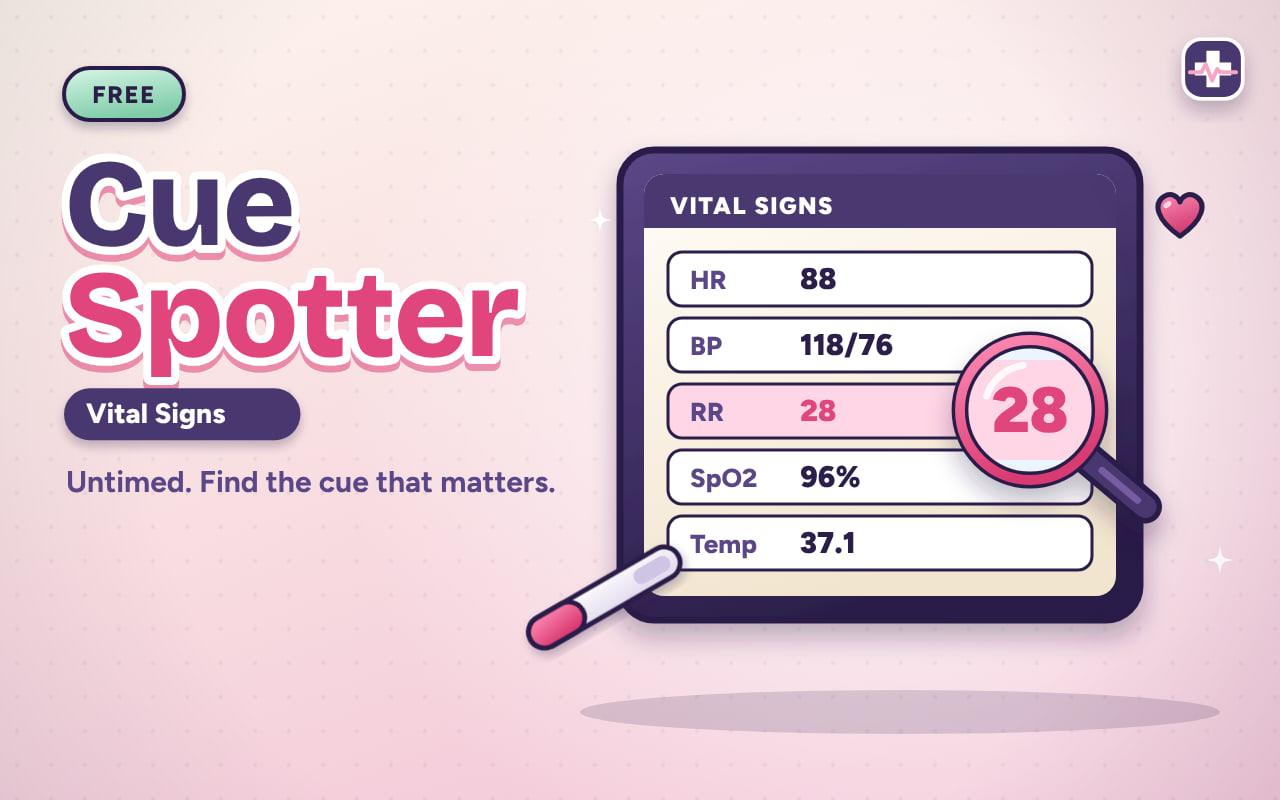
Vital Signs and Cue Spotter
Untimed. Find the cue that matters.
Make a free account to start.
What it is
Cue Spotter is an untimed vital signs game. Each patient shows a set of vital signs and a short story, and your job is to find the cue that matters: the one value that is abnormal, or the normal-looking value that is not normal for this patient.
After each pick you get the why: the normal adult range, what pulls the value up or down, and what the nurse does next. Baselines matter, so a blood pressure that is fine for one patient can be a red flag for another.
It is calm by design: no timers, soft sounds, and tap-friendly controls on any phone.
What you'll learn
- Normal adult ranges for heart rate, blood pressure, respiratory rate, oxygen saturation, temperature, and pain
- How to compare a value to the patient baseline instead of a textbook number
- Which changes are early signs of deterioration
- How to tell an expected finding from one that needs action
- How recognize cues shows up on Next Gen NCLEX items
How it helps you
NCLEX tests clinical judgment, using NCSBN's Clinical Judgment Measurement Model. Every NURSYN game is built on the nursing process. Vital Signs and Cue Spotter works these ADPIE steps: Assessment, Diagnosis.
- Covers Assessment and Diagnosis: collect the data, then decide what it means
- Recognize cues is the first step of the NCSBN Clinical Judgment Measurement Model
- Untimed practice builds the pattern before speed matters
- Pairs with Skills Lab in Level 1 of the Curriculum Pathway
How to play
- Read the patient story and the vital signs
- Tap the value that is the cue that matters
- Read the rationale and the normal range
- Decide the next nursing action
- Keep going at your own pace
Clinical topics covered
Sources
The clinical content and the teaching approach behind this game line up with these references.
- The Nursing ProcessAmerican Nurses Association. Assessment, diagnosis, outcomes and planning, implementation, and evaluation.
- NCSBN Clinical Judgment Measurement ModelNCSBN. The framework NCSBN uses to measure clinical judgment and decision making on the NCLEX.
- Game-thinking: utilizing serious games and gamification in nursing education, a systematic review and meta-analysis (Nylén-Eriksen et al., 2025). BMC Medical EducationBMC Medical Education. Pooled studies show serious games and gamification work in nursing education, with the strongest benefit for knowledge and a more modest effect on skills.
Related games
For education only. Cases and patients are fictional. Always follow your program, current guidelines, provider orders, and facility policy.